
In this in-depth guide, you’ll find everything you need to know about babysitting costs in Poland, from teenage sitters to professional nannies. We’ll break down the average hourly rates, how much to pay based on age, experience, and location, and how extra tasks like cooking or caring for multiple children can impact the rate.
Wondering how much a babysitter costs in Poland in 2026? Whether you’re looking for a student for occasional evening help, or a professional nanny with experience and qualifications, childcare rates can vary significantly depending on location, experience, and scope of duties.
In this article you’ll find average hourly rates, real-life examples, and practical tips to help you set a fair and appropriate rate for childcare.
Average childcare rates in Poland (2026)
According to current data, the average hourly rate for babysitters in Poland in 2026 is between 20 and 30 PLN gross, though in practice this can vary depending on the city and the experience of the person providing care. For example, in Warsaw, babysitters often earn between 30 and 50 PLN per hour, reflecting the higher cost of living and greater demand for childcare.
In other large cities such as Kraków, Wrocław, or Poznań, typical rates are between 28 and 38 PLN per hour. In smaller cities and rural areas, rates may be lower.
Location is only one factor. The rate is also influenced by:
- the babysitter’s age and experience,
- qualifications (e.g. a first aid course, a pedagogical education),
- the number and age of the children,
- the type and frequency of care (occasional, regular, evening, etc.),
- the detailed scope of duties (e.g. preparing meals, school pick-ups).
Table: Average childcare rates in Poland by location (2026)
| Location | Typical hourly rate (PLN) | Notes |
|---|---|---|
| Warsaw | 30–50 PLN | Highest rates — strong demand and high cost of living |
| Kraków, Wrocław, Poznań | 28–38 PLN | Other large cities with high demand |
| Medium-sized cities (e.g. Lublin) | 25–30 PLN | Rates vary by region and need |
Data drawn from market research, childcare platforms in Poland, and Sitly’s internal analysis.
Who you hire significantly affects financial expectations:
- A professional nanny (with qualifications, a fixed schedule, sometimes living with the family) typically charges between 35 and 50 PLN per hour, or receives a monthly salary of between 3,000 and 5,000 PLN, depending on the scope of duties and location.
- A 16- or 17-year-old student who looks after children occasionally might offer rates of 25 to 30 PLN per hour, especially in smaller towns, often close to the minimum hourly rate, which in 2026 is 28.10 PLN gross.
When setting a rate, it’s worth considering not just the number of hours worked, but also the level of responsibility involved. Looking after an infant, several children, preparing meals, or picking children up from preschool or school are tasks that can justify a higher rate.
On Sitly, you can browse the profiles of nannies and babysitters available in your area and see what their hourly rates are. You can also post a job listing, specifying how much you’re able to pay and what kind of care you need.
This way, you and the babysitter can agree together on a fair rate that reflects the time, commitment, and scope of duties involved.
Childcare rates and the minimum wage in Poland
Poland has a national minimum wage, which can apply to babysitters and nannies. Whether it actually applies in a given situation, however, depends on the type of contract and the nature of the working arrangement. Babysitters in Poland can be employed under one of three main types of contract:
Umowa o pracę (employment contract) — This is a formal employment contract that includes fixed working hours, social insurance, paid leave, and other rights under the Labour Code.
Umowa zlecenie (contract of mandate) — This is a civil-law contract, more flexible and often used for casual or part-time work, such as childcare. It still requires the minimum hourly rate to be observed, provided that working time can be recorded.
Umowa uaktywniająca (activating contract) — This is a special form of contract of mandate used when hiring a nanny for a child up to 3 years old. In this case, part of the social insurance contributions is paid by the state, making it a beneficial solution for both the family and the babysitter. The conditions for concluding it are set out in the applicable regulations.
Minimum wage in Poland (as of 2026)
Minimum gross monthly wage: 4,806 PLN
Minimum gross hourly rate: 31.40 PLN
(Source: Government of the Republic of Poland — Ministry of Family and Social Policy)
When does the minimum wage apply?
Your babysitter is likely entitled to at least the minimum wage if:
- She works regularly for your family
- She has a formal contract signed (umowa o pracę, umowa zlecenie, or umowa uaktywniająca)
- Her working time is recorded and paid
- She is not a family member or a volunteer
Under an employment contract (umowa o pracę), the minimum wage always applies, along with additional rights such as paid leave, sick leave, and pension contributions.
Under a contract of mandate (umowa zlecenie), the minimum hourly rate of 28.10 PLN must also be observed if working time can be measured (which is usually the case with childcare). It’s worth remembering, though, that this type of contract doesn’t offer the same protections as an employment contract.
In practice, for children up to 3 years old, the so-called umowa uaktywniająca is often used, a special form of contract of mandate in which part of the social insurance contributions is financed by the state. The minimum hourly rate also applies in this case.
Hourly rate or a flat rate? Which is more common in Poland?
In Poland, most babysitters are paid by the hour, particularly for casual, flexible, or last-minute care. This ensures fair payment for the time and effort actually worked, and it’s most common for evening care or occasional support.
That said, in ongoing arrangements, for example when care takes place regularly on the same days and for a similar number of hours, parents and the babysitter sometimes agree together on a flat rate for a set period of care, regardless of small variations in the number of hours worked.
An hourly rate works best when:
- The schedule changes from week to week,
- The scope of duties varies (e.g. dinner, bath time, school pick-up),
- You sometimes need last-minute help,
- You want to make sure the babysitter is paid fairly even if plans change.
This way, the babysitter is paid for every hour (or part of an hour) worked, especially if extra, unexpected duties come up.
A flat rate can work well when:
- care takes place regularly and according to a set schedule (e.g. every Saturday, 6pm–11pm),
- there are no additional tasks and the children are usually already asleep, and both sides prefer a simple, predictable arrangement without having to calculate every hour.
Worth keeping in mind when agreeing a flat rate:
- Agree in advance what’s included in the rate: number of children, any minor household duties, late-evening hours, travel reimbursement.
- Don’t set the rate too low if the scope of duties may change or the care time may run over.
- It’s worth offering an extra amount or bonus if the babysitter stays longer, prepares a meal, or deals with an unexpected situation.
How do experience and qualifications affect babysitter rates?
A babysitter’s experience, training, and certificates have a significant effect on her rate, and that’s entirely natural. It’s not just about age, but above all about competence, responsibility, and the scope of duties entrusted to her.
For example: a 20-year-old studying early years education, or someone with a first aid course, might expect a rate of 30–40 PLN per hour, depending on the city and scope of duties.
Even a 15-year-old with childcare experience, who the family knows well and trusts for her responsibility, may propose a higher rate than someone without experience. In practice, a simple rule applies: the greater the skills and qualifications, the higher the expected rate.
It’s an individual decision
As a parent, you’re best placed to know what works for your situation. Do you feel comfortable hiring someone who’s just starting out and offers a somewhat lower rate to gain experience?
Or would you rather work with someone with a relevant education and additional courses, and are you willing to pay more in exchange for greater peace of mind? There’s no single “right” answer, what matters most is an agreement that works for both sides.
If you’re looking for guidance on how to fairly calculate a babysitter’s pay, take a look at the examples below.
What duties does your babysitter have?
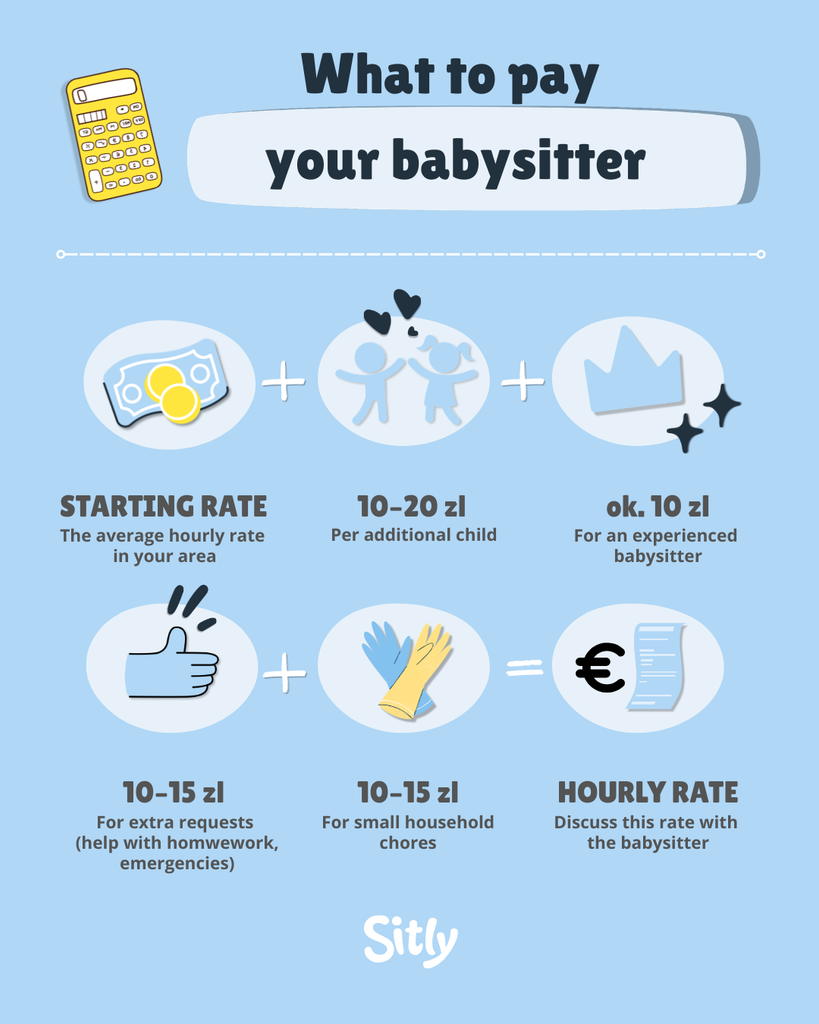
The hourly rate doesn’t depend only on age or experience, it also matters what duties the babysitter carries out while looking after the child. If the scope of duties goes beyond standard care, it’s worth reflecting this in the pay.
Looking after several children
Looking after two or three children at once is significantly more demanding than looking after one child. It requires greater engagement, the ability to divide attention, and more energy. In such cases, the hourly rate should be correspondingly higher.
A child with special needs
If your child has health issues, behavioural difficulties, or requires constant supervision, offering a higher rate is entirely justified. It reflects respect for the babysitter’s work and the responsibility she takes on.
Example: Babysitter (18 years old) — looking after three children, including preparing dinner
Zuzia is 18 and has plenty of childcare experience. She recently started a course to prepare for working in a preschool and has completed first aid training. Once a week, she looks after three children aged 8, 5, and 3. She starts work at 3pm, picking up the older children from school and the youngest from preschool, then takes them home for a snack and playtime. The parents also appreciate that she prepares a simple dinner, so the whole family can eat together when they get home around 5:30pm.
What’s a Fair Rate for Zuzia? Breakdown of her rate:
- 31.40 PLN/hour → minimum wage in Poland (2026) for an 18-year-old
- 6.00 PLN/hour → for looking after additional children (three in total)
- 4.00 PLN/hour → for experience and her first aid certificate
= 41.40 PLN/hour - Zuzia works for 2.5 hours, so her pay is:
- 38.10 PLN × 2.5 = 103.50 PLN
The family rounds the amount up to an even 110 PLN per visit, a fair and convenient solution for both sides.
Baby care versus care for an older child
The child’s age matters a great deal when setting a fair rate for care. Looking after a baby or toddler requires constant attention and full engagement. In a short space of time, a babysitter may need to feed, change, soothe, and keep the child occupied, often doing several things at once. This level of responsibility justifies a higher hourly rate, especially if the babysitter has experience with babies or has completed a first aid course.
If you’re not sure whether your child is ready to be left with a babysitter, take a look at our guide: When is a baby old enough for a babysitter?
For children over six, the babysitter’s role is usually less demanding. Older children can eat, use the toilet, and occupy themselves independently for longer stretches. This means a smaller scope of duties, which sometimes translates into a lower hourly rate.
General rule: the younger and more dependent on adults a child is, the greater the responsibility, and so the higher the pay for their care.
Household duties and light chores
If, alongside childcare, you’re asking the babysitter to help with a few household duties as well, raising her rate is entirely reasonable. Her main job is looking after the children, but if she also cleans, folds laundry, or prepares meals, this should be reflected in her pay.
For comparison: in Poland, a cleaner typically earns between 25 and 40 PLN per hour, depending on location. If a babysitter is handling both childcare and household duties, her rate should be higher than the standard rate for childcare alone.
Typical tasks that can justify a higher rate:
- vacuuming shared rooms,
- loading and unloading the dishwasher,
- folding and sorting laundry,
- washing up after meals,
- preparing dinner for the children or the whole family.
Evening care vs. daytime care
Does the babysitter only come in the evening, or does she also help with the children after school? Evening care is often better paid. In some cases, families and babysitters agree a flat rate for the whole evening or night, or a lower hourly rate after a certain time, particularly if:
- the children are already asleep by the time the babysitter arrives
- the care required in the evening is fairly minimal
Example: Babysitter (16 years old) — two children, weekend evening care
Maja is 16 and in her second year of secondary school. She has over two years of babysitting experience, mainly looking after her younger brother and cousins. Every so often, she looks after two children on Saturday evenings. She arrives at 7:30pm, once the children are already asleep, and stays until 11:30pm. The parents always drive her home. They also provide snacks and ask her to empty the dishwasher while she’s there.
What’s a reasonable rate for Maja?
- 18.00 PLN/hour → suggested rate for a teenage babysitter with light duties
- 4.00 PLN/hour → for the second child in her care
= 22.00 PLN/hour
However, since the children are already asleep and the scope of duties is very light, Maja and the parents agree together on a flat rate of 20 PLN/hour.
Payment for the evening:
20 PLN × 4 hours = 80.00 PLN
Maja is very happy with this arrangement: the evening is calm, she feels trusted by the parents, and the rate reflects the scope of her duties.
Babysitter for an emergency or last-minute care
Need a babysitter urgently? This kind of flexibility usually comes with a higher rate. A last-minute request, especially early in the morning or in an emergency (e.g. when a child wakes up with a fever), can mean the babysitter has to change her plans or reorganise her entire day.
In these cases, it’s good practice to offer a somewhat higher hourly rate, as a way of recognising her availability and commitment. Being able to rely on emergency care is a real convenience, so it’s worth making sure it’s fairly rewarded.
Example: Babysitter (21 years old) — one child, after-school care including preparing lunch
Nina is 21 and studying early years and pre-primary education. She holds a first aid certificate, and this semester she has a flexible timetable at university.
Every Wednesday afternoon, she looks after one child for the same family. She picks up the 6-year-old boy from school at 3pm, prepares his lunch, plays with him, and stays until the parents get home, around 6pm. The boy is very energetic, so Nina is fully engaged the whole time she’s there. The parents provide all the ingredients for lunch and reimburse small expenses, such as bus fares or snacks.
What would be a fair rate for Nina?
- 32.00 PLN/hour → typical rate for a qualified babysitter in a large city
- 3.00 PLN/hour → for her first aid certificate and relevant education
= 35.00 PLN/hour
- 3.00 PLN/hour → for her first aid certificate and relevant education
Nina works for 3 hours, so the total amount is:
35.00 PLN × 3 = 105.00 PLN
Talking about pay with your babysitter
Once you’ve decided on a fair hourly rate, the next step is to have an open, honest conversation with the babysitter. Conversations like this can feel a bit awkward, especially if you’re hiring a babysitter for the first time, but agreeing things clearly from the start helps avoid misunderstandings later on.
A good approach is to ask the babysitter whether she already has a rate in mind. Most babysitters, especially teenagers and students, have a general idea of what they’d like to earn, based on their experience, age, or rates among friends.
If both sides approach the conversation realistically and can explain the reasoning behind their proposal, it will be much easier to reach an agreement that works for everyone and holds up in the long run.
Respect and openness are key in this kind of conversation. It builds trust and helps the babysitter feel valued and motivated, making her more likely to want to keep working with the family long-term.
How much should you pay a babysitter in Poland?
There’s no single, universal answer to this question, since every family and every babysitter is in a different situation with different needs. Pay depends on many factors, such as:
- the babysitter’s age, experience, and qualifications (e.g. a first aid course, relevant education)
- the number of children and their ages,
- additional duties (e.g. preparing meals, helping with homework, light chores),
- the time of day (daytime, evening, or night-time care),
- location — rates in larger cities such as Warsaw, Kraków, or Wrocław are usually higher than in smaller towns,
- and, of course, your budget.
In practice, it all comes down to finding a balance between fair pay for the babysitter and affordable costs for the family. Good communication is the foundation of a good working relationship. Talk openly, say what you expect and what you’re able to offer. When both sides clearly lay out their expectations, it’s much easier to reach a rate that works for everyone.
Table of contents


FAQ

In 2026, most parents in Poland pay babysitters between 25 and 35 PLN per hour. Rates vary depending on location, the babysitter’s experience, and the number of children.
In larger cities such as Warsaw, Kraków, or Wrocław, babysitters often ask for 30–50 PLN per hour, or even more than 50 PLN, while in smaller towns or rural areas, rates are usually between 20 and 28 PLN per hour.
Yes, most babysitters in Poland charge a higher rate when looking after more than one child.
A typical surcharge is 5 to 10 PLN per hour for each additional child, depending on their age and individual needs.
Rates for babysitters in Warsaw are among the highest in Poland, starting at around 30 PLN per hour and often exceeding 50 PLN, particularly for experienced babysitters.


Trusted sitters, right around the corner
Need a little help? Sitly connects you with experienced babysitters in your area. Whether you need occasional or regular care, finding the right babysitter is super easy. Browse profiles, read reviews, and reach out to your favorites right away.

Related Articles
When is a baby old enough for a babysitter?
Wondering when your baby is old enough for a babysitter? While there’s no single “right” age, short and gradual separations are possible even in the early months when the babysitter is experienced and routines are respected.
Calculate Your Babysitter’s Rate with the Sitly Calculator
Find out how much to pay a babysitter in your area. Sitly’s Babysitter Rate Calculator shows average rates across Poland and helps you estimate a fair hourly wage based on your city, number of children, and any extra duties. Get a clear and personalized indication of what families and babysitters usually agree on.
10 Ways to Help Your Child Overcome Fear of Monsters at Bedtime
If your child is afraid of monsters at bedtime, you’re not alone. Many kids aged 3 to 6 struggle with nighttime fears fueled by imagination and change. In this article, you’ll learn why these fears happen, how to validate them, and 10 simple, creative ways to help your child feel safe and sleep peacefully. From using nightlights and comforting routines to anti-monster sprays, magic spells, and stuffed animal bodyguards—each idea is designed to reduce anxiety and empower your child at night.